Welcome reader, to my very first blog post ever! In these series of posts I will lay out what I am working on and try to explain what is going through my head as I finish a dissertation in the pursuit of an MSc in Sound Design from the University of Edinburgh.
At this point, I am looking to create a browser-based application for anyone to use and explore sound design concepts that I am inspired by. I want to make a program that is easily accessible to anybody on the internet to play around with fun things like amplitude modulation and time stretching.
I am working my way through Daniel Shiffman’s The Coding Train Youtube series on p5.js. All of my programming experience leading up to my admission at The University of Edinburgh was self-taught, with the aid of Harvard University’s CS50 class found on EDX.com. This will be my first serious foray into Javascript and building web-based applications.
The other main work I have done is prototyping some basic functionality for the final product in Max MSP. So far I have made three fun little tools, all based around the concept of recording something accessible in the user’s computer microphone, such as their voice, a clap, or in my case: a slinky.
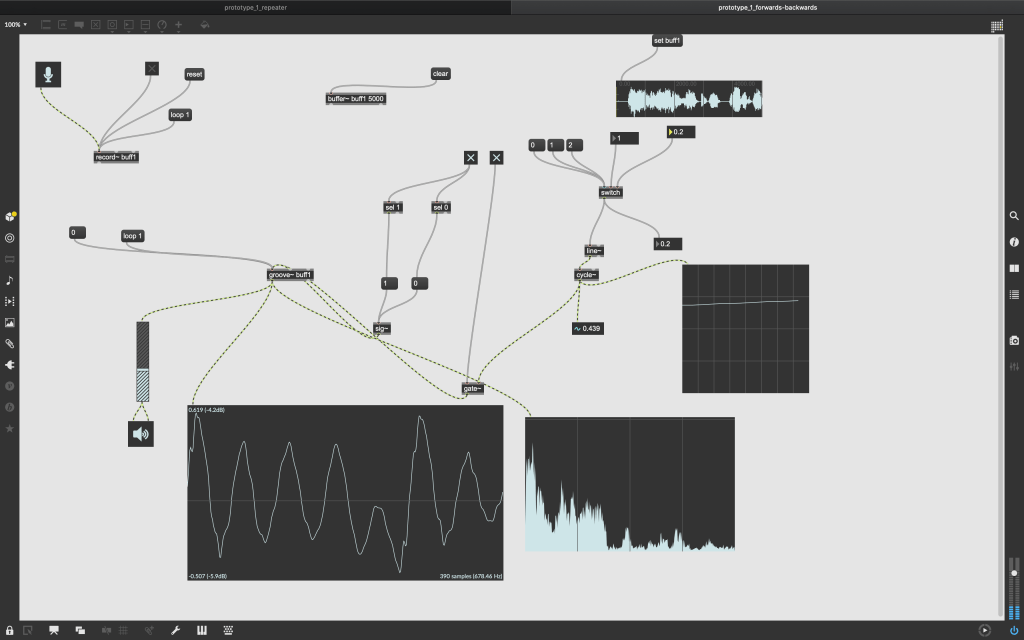
The first Max MSP prototype was setting up a buffer~, record~, groove~ combination to record my voice into Max and just play around. I haven’t touched Max MSP since the end of my first semester here, and it was really nice going back to it. I just wanted to get my hands dirty again and dig a little more into the groove~ object since I have only scratched the surface on it and I know it is a foundational component to Max MSP. Groove~ is a ‘variable-state’ playback object. Which I take to mean it will play what is in the buffer it’s connected to at variable speeds and directions. If a “1” is given as a parameter to Groove~, it will playback forwards in time at normal speed. If a “-1” is given as a parameter, it will play backwards at normal speed. “0.5” for halftime forwards, “-2” for backwards twice as fast, and so on. I had a lot of fun experimenting with low frequency oscillators (LFOs) to hear my own voice altered in strange ways. Connecting a sine-tone oscillator at 0.5 Hz will smoothly vary the playback from backwards at full speed to forward at full speed, but hit every point in between (within reason). This may seem basic to experienced Max MSP programmers, but was a really exciting discovery for me.
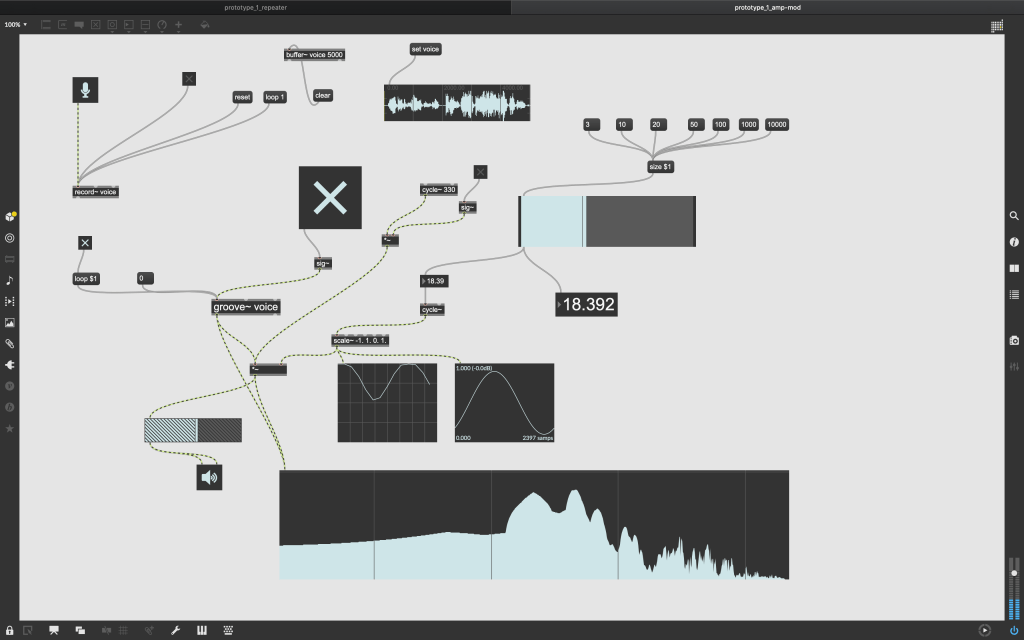
The second Max MSP prototype was designed to play with amplitude modulation. Amplitude modulation is a very special audio effect to me and is one of the core concepts I hope to allow people who are not audio professionals to experiment with and understand. As I understand it, amplitude modulation is basically altering the volume of a signal fast enough to create an effect beyond simply “flipping the lights switch on and off really fast”. By oscillating the amplitude (basically a wave’s size, which in most cases is just volume) of a signal fast enough, an actual tone will become audible to the listener. This process fascinates me. It seems like this process should break the First Law of Thermodynamics by creating something out of nothing! By just changing the volume of a thing really fast, you get another thing! Seems like magic. This effect is less noticeable with the human voice than with a simple tone, but is still there. By creating a simple GUI using sliders in Max MSP, it was really easy to play with this concept and see the waves do their thing. More to come on amplitude modulation.
The third and final Max MSP prototype was inspired by an audio effect I heard on the outro music for Vox Media’s podcast “Today, Explained”. The producers of this podcast source most of their music from a single composer, Breakmaster Cylinder. On episode “Second in command, first in history”, the outro is a moving speech by Vice President Kamala Harris, sitting on top of a piece called “Lonely Shuttle” by Breakmaster Cylinder. I highly recommend this episode to anyone interested in American history, but if you don’t have time for a full half-hour podcast, please just skip to 25:01 and hear this speech over this music.
There is a repeating, or stutter effect on the drums in this track that I have never heard before. It is not exactly a delay, as there is no natural tail to the sound. I created another GUI using sliders to set the start/stop points for the Groove~’s loop function. This way I can isolate a single sound to loop out of the buffer and not mess with buffer size. There are two ways for the loop playback to be messed with at this point. One way is feeding three different sliders through the sig~ object (which tells Groove~ what speed and direction to playback): one slider for a static speed variable (0. – 7.), one controlling the frequency of a sine wave oscillator (0. – 128.), and one controlling the amplitude of the sine LFO (0. – 3.). This gives the user a basic slow/fast control, then two different oscillator parameters for something similar to amplitude modulation. Not sure what that effect would be called. The second way to play with the looping Groove~ is automatic, or generative, or algorithmic, not sure what to call it. There is one oscillator scaled to go between 0.3 and 5. Hz controlling the playback speed. Then a second oscillator scaled between 1. and 7., modulating the upper ceiling of the first oscillator (so that 5. number actually doesn’t mean anything I’m just now realizing). This combination can create some interesting rhythmic effects just from a single sound. Also both ways of playing with the Groove~ playback can be easily flipped to go forward or backward using a [*~] object and two messages, a “1” and a “-1”, to pick between.

I promise that by the next blog post, these patches will be all cleaned up and labelled. I will also spend some time writing about my influences going into this project. Thank you for reading!

 Chris Duvall
Leave a comment